Avoid Costly Mistakes: How Using the Wrong Jack Size Can Damage Your Car
The short answer is yes—using the wrong car jack is a common mistake that can lead to serious, expensive damage. From bent frames and cracked body panels to the serious safety risks involved, we're covering the specific dangers you need to be aware of.
The Short Answer: Yes, and Here's How
Using the wrong size jack on your vehicle is not just a minor inconvenience; it's a significant risk that can lead to costly damage and serious personal injury. The term "wrong size" doesn't just refer to the physical dimensions of the jack but encompasses its weight capacity, lift height, and the shape of the saddle (the part that contacts the car). When any of these factors are mismatched with your vehicle's requirements, you're creating a recipe for disaster.
From crushed body panels and bent frames to a catastrophic failure that causes the vehicle to fall, the consequences are severe. A car jack is a tool that lifts thousands of pounds of metal off the ground, and it must be treated with respect. Understanding the specific ways a mismatched jack can harm your car is the first step toward ensuring you always perform this common maintenance task safely and correctly.
Unpacking the Damage: Specific Risks of Using the Wrong Jack
The potential for damage is multifaceted, affecting different parts of your vehicle in various ways. It’s crucial to understand these specific risks to appreciate why selecting the right jack is non-negotiable.
Risk 1: Insufficient Weight Capacity
Every car jack has a clearly stated weight capacity, such as 1.5 tons, 2 tons, or 3 tons. This number represents the maximum load the jack is certified to lift safely. Using a jack with a weight rating that is too low for your vehicle is one of the most dangerous mistakes you can make. For example, trying to lift a heavy SUV or truck with a small 1.5-ton jack designed for a compact sedan puts immense strain on the jack's mechanical and hydraulic components.
When overloaded, the jack can fail in several ways. The metal arms can buckle or bend, the hydraulic seals can blow out, or the internal screw mechanism can strip. This results in a sudden and uncontrolled drop of the vehicle. The resulting impact can damage suspension components, crack wheels, or worse, cause the car to fall on anyone working underneath. It's important to remember you're only lifting a portion of the car's weight, but it's always safest to use a jack rated for at least three-quarters of your vehicle's total curb weight.
Risk 2: Incorrect Lift Height and Stability
A jack's "size" also refers to its lift range—its minimum height and maximum height. If a jack is too tall, you may not even be able to slide it under your vehicle, especially with modern cars that have lower ground clearance. Conversely, if a jack is too short, it may not be able to lift the wheel high enough off the ground to allow you to change a tire. This can tempt people into dangerous improvisations.
Never stack blocks of wood or bricks under a jack to gain extra height. This creates an extremely unstable lifting point. The blocks can split, slip, or crush under the immense pressure, causing the jack to tilt and the car to slide off. A stable lift requires the jack to be on a flat, solid, level surface. Using an improperly sized jack that forces you into a compromised setup dramatically increases the risk of the car shifting and falling.
Risk 3: Damage to the Vehicle's Frame and Body
Perhaps the most common type of damage from improper jacking comes from placing the jack in the wrong location. Every vehicle has specific, manufacturer-designated "jack points" or "lift points." These are areas of the frame or unibody that are specially reinforced to handle the concentrated force of lifting the car's weight. These points are often located on the pinch welds along the side of the car or on a solid part of the frame.
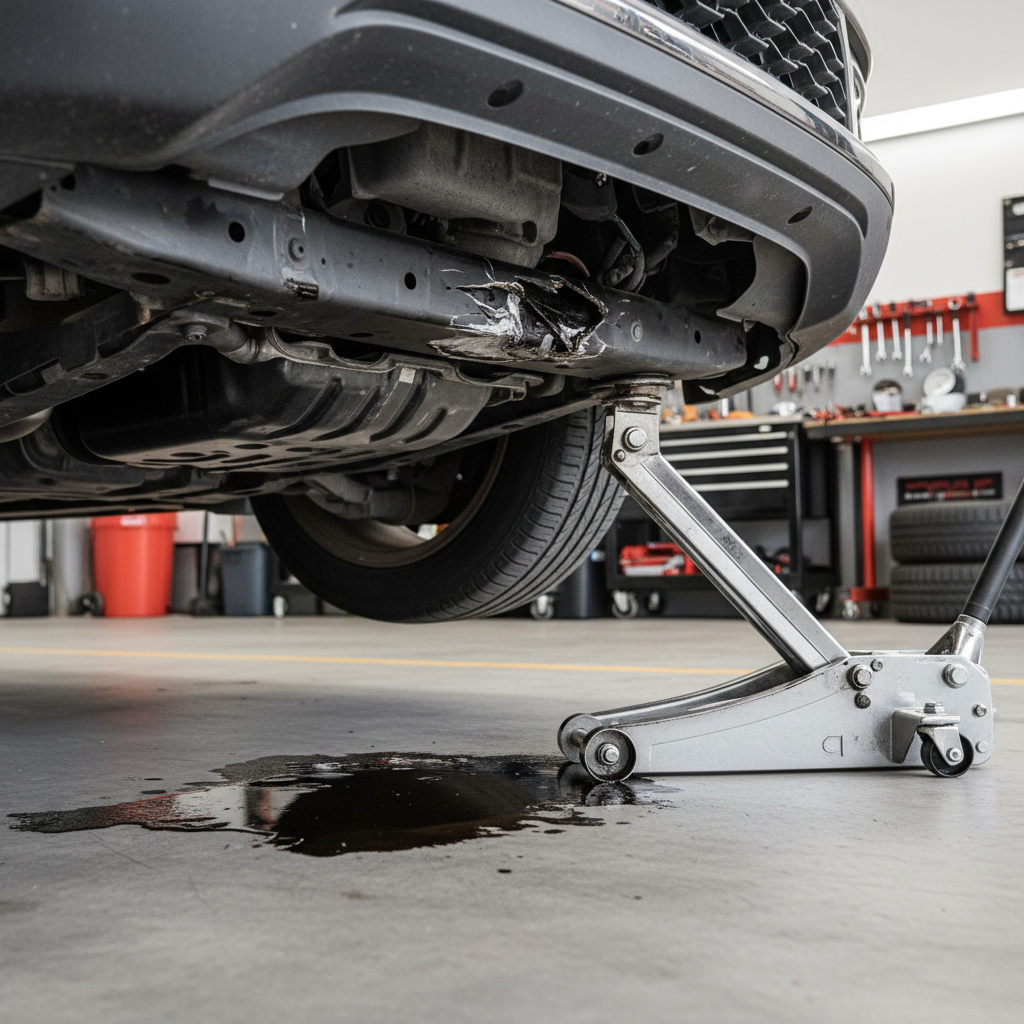
If you place the jack saddle on a random spot under the car, you are applying thousands of pounds of force to an area not designed to support it. This can easily lead to bent or crushed pinch welds, which can make it difficult to use the proper jack points in the future. More severe damage includes dented rocker panels, punctured floor pans (leading to rust and water leaks), and in the worst cases, a bent or compromised frame, which can affect the vehicle's alignment and structural integrity.
Risk 4: Damaging Undercarriage Components
The underside of your car is a complex network of critical components. A misplaced jack can cause devastating and expensive damage to these systems. Placing a jack on the engine's oil pan can crack it, causing all your oil to drain out. Placing it on the gas tank could lead to a puncture and a dangerous fuel leak.
Other vulnerable parts include the exhaust system, which can be easily bent or crushed, and delicate suspension components like control arms. Brake lines and fuel lines also run along the undercarriage and can be crimped or severed by the pressure of a jack. This type of damage is not only costly to repair but can also create an immediate and severe safety hazard if not discovered before driving the vehicle.
Why Jack Ratings and Lift Points Are So Crucial
To prevent the damage described above, it is essential to understand the "why" behind jack ratings and lift points. A jack's weight rating isn't arbitrary; it's the result of engineering and testing to ensure it can perform its function without failing. For example, a 2-ton jack is rated to lift 4,000 pounds. While your car might weigh 5,000 pounds, you are typically only lifting one corner at a time, which might be around 1,250-1,500 pounds. The higher rating provides a critical safety margin to account for uneven weight distribution and dynamic forces.
Similarly, lift points are not optional suggestions—they are a structural necessity. A car's unibody or frame is designed to distribute forces across its entire structure during driving and in the event of a collision. However, the force exerted by a jack is incredibly concentrated into a very small area. Only the reinforced lift points are built with the extra steel and structural support needed to withstand this pressure without deforming. You can almost always find the correct locations for these points in your vehicle's owner's manual. They are often indicated by a small arrow or notch on the pinch weld beneath the doors.
Common Questions About Car Jacks
Beyond the immediate question of damage, many drivers have follow-up questions about selecting and using jacks correctly. Addressing these is key to developing safe habits.
How Do I Choose the Right Jack for My Car?
Choosing the right jack involves three primary considerations: weight capacity, lift range, and jack type. First, determine your vehicle's curb weight, which can be found in the owner's manual or on a sticker inside the driver's side door jamb. As a rule of thumb, select a jack with a weight capacity that is at least 75% of your vehicle's total weight. This provides a generous safety margin. For a 4,000 lb car, a 1.5-ton (3,000 lb) jack is technically enough, but a 2-ton (4,000 lb) jack is a much safer choice.
Next, consider the lift range. Measure the ground clearance of your vehicle at the jacking points. Ensure the jack's minimum height is low enough to fit underneath. Then, determine how high you need to lift the car to get the wheel off the ground and choose a jack with a maximum lift height that comfortably exceeds that. Trucks and SUVs will require a jack with a much higher lift range than a sports car.
What's the Difference Between a Scissor Jack and a Floor Jack?
The two most common types of jacks are scissor jacks and floor jacks (also known as trolley jacks). The scissor jack is what typically comes with your car's spare tire kit. It's operated by turning a long screw, which causes the diamond-shaped mechanism to expand and lift the car. They are lightweight and compact, making them ideal for roadside emergencies. However, they have a narrow base, making them less stable, and they can be slow and difficult to operate.
A floor jack is a much more robust tool intended for garage use. It uses a hydraulic cylinder operated by pumping a long handle, making it easy to lift heavy vehicles quickly. They are built with a wide, low-profile frame and wheels, which makes them far more stable than scissor jacks. While too heavy and bulky to carry in your trunk, a quality floor jack is an essential tool for anyone planning to do regular maintenance like tire rotations or brake work at home.
Can a Car Jack Fail and What Should I Do?
Yes, any jack can fail, even if it's the correct size and used properly. Hydraulic jacks can develop leaks in their seals, causing them to slowly lose pressure and lower the vehicle. Mechanical jacks can suffer from metal fatigue or stripped threads over time. This is precisely why the single most important rule of working on a vehicle is to never get under a car that is supported only by a jack.
A jack is a tool designed for lifting, not for holding. Once you have lifted the vehicle to the desired height, you must place certified jack stands under a solid part of the vehicle's frame to support the load. Gently lower the car onto the jack stands until they are bearing the full weight. The jack stands provide a stable, mechanical lock that cannot fail the way a hydraulic jack can. Always work on a level surface, chock the wheels that remain on the ground, and use jack stands—your life could depend on it.
Final Thoughts on Jack Safety
The answer is clear: using the wrong size jack can absolutely cause significant damage to your car. From cosmetic issues like bent body panels to severe structural harm and the failure of critical undercarriage components, the risks are too high to ignore. More importantly, improper jacking practices pose a grave threat to your personal safety.
Always verify your vehicle's weight and identify the correct lift points before starting any job. Invest in a high-quality jack with an appropriate weight capacity and lift range for your needs. And above all, never work on a vehicle unless it is securely supported by a set of properly rated jack stands. Taking these simple precautions will protect both your car and your well-being.
For more information, you can refer to these resources: