Discover the Prestigious Selection: Top 10 Luxury Watches for Men
When it comes to luxury watches, a few iconic names immediately stand out for their unparalleled craftsmanship, rich heritage, and timeless design. We’ve curated the definitive list of the top 10 timepieces that every man should know, from legendary Swiss classics to modern horological marvels.
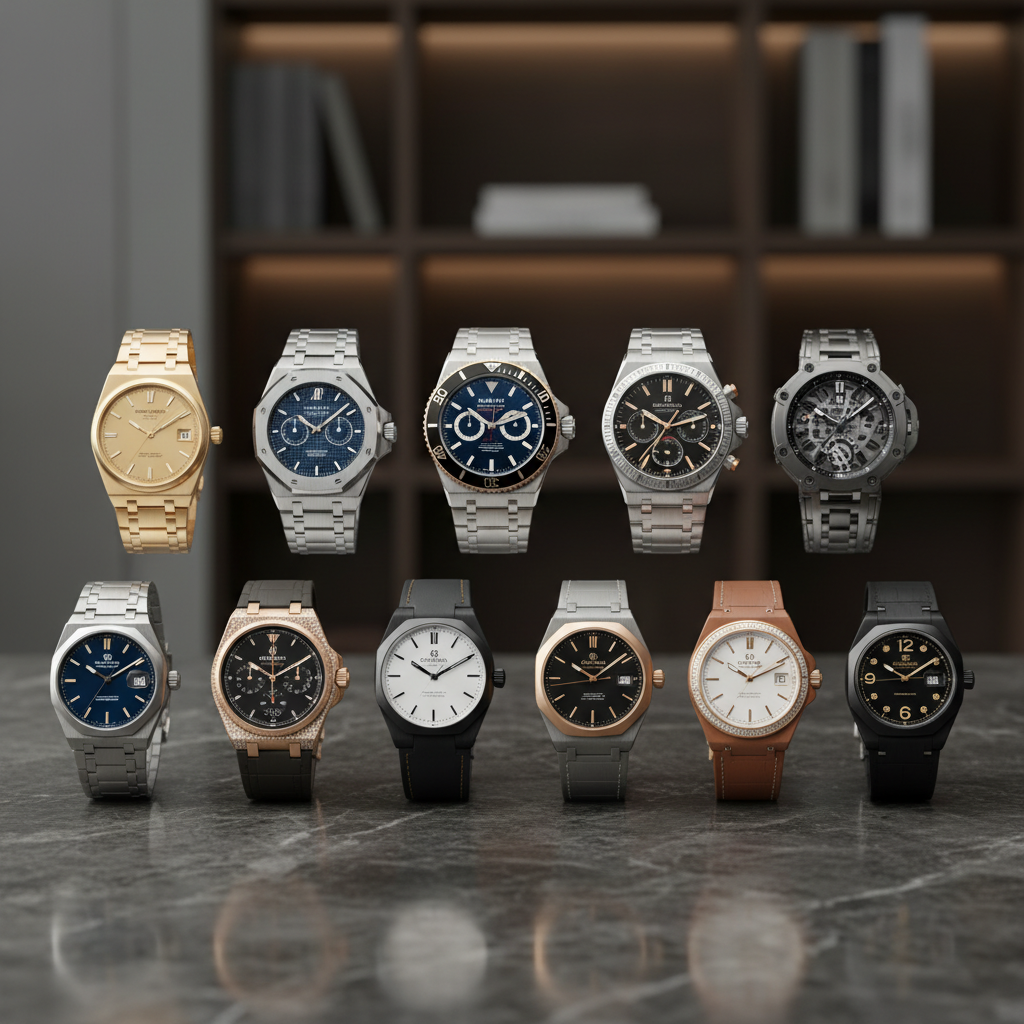
Exploring the Pinnacle of Men's Timepieces
The world of luxury watches is a fascinating blend of artistry, engineering, and history. For many, a fine timepiece is more than just a way to tell time; it's a statement of style, a piece of heritage, and an appreciation for meticulous craftsmanship. These instruments are built to last for generations, often becoming treasured family heirlooms. From iconic dive watches that have explored the deepest oceans to elegant dress watches that have graced the wrists of world leaders, each model has a unique story to tell. Here we explore ten of the most revered and sought-after luxury watches for men, each a titan in the industry for its own distinct reasons.
1. Rolex Submariner
Often considered the quintessential dive watch, the Rolex Submariner is arguably one of the most recognizable timepieces in the world. First introduced in 1953, it set the standard for underwater functionality with its rotating 60-minute bezel, robust Oyster case, and exceptional water resistance. The Submariner's design is a masterclass in functional elegance, making it equally at home with a wetsuit or a business suit. Its appeal lies in its rugged reliability and timeless aesthetic that has remained largely unchanged for decades, proving that a perfect design needs little alteration.
Modern Submariners feature Rolex's proprietary Cerachrom bezel, which is virtually scratchproof and resistant to fading from UV rays. The watch is powered by a superlative chronometer-certified automatic movement, ensuring precision and a hefty power reserve. Its combination of historical significance, unwavering performance, and iconic looks makes the Submariner a benchmark against which all other sports watches are measured and a cornerstone of any serious collection.
2. Patek Philippe Nautilus
Designed by the legendary Gérald Genta and launched in 1976, the Patek Philippe Nautilus shattered conventions with its bold, porthole-inspired case and integrated bracelet. At a time when luxury watches were typically small and made of gold, the Nautilus was a large, stainless steel sports watch with an audacious price tag. Its slogan, "One of the world's costliest watches is made of steel," captured its revolutionary spirit. The octagonal bezel with its rounded corners and the horizontally embossed dial are its most defining features.
The Nautilus exudes a sense of "casual elegance," a watch that is both sporty and incredibly refined. The level of finishing on the case, bracelet, and the in-house movement is extraordinary, visible through the sapphire crystal case back. Owning a Nautilus is often seen as reaching the apex of watch collecting, due to its incredible demand, prestigious brand heritage, and the perfect fusion of robust design with haute horlogerie (high watchmaking).
3. Audemars Piguet Royal Oak
The watch that created the luxury steel sports watch category, the Audemars Piguet Royal Oak, was another Gérald Genta masterpiece from 1972. Its most striking feature is the octagonal bezel secured by eight visible hexagonal screws, a design inspired by a traditional diver's helmet. This industrial-chic aesthetic was groundbreaking at the time and remains incredibly influential today. The watch is famous for its integrated bracelet, which flows seamlessly from the case and plays with light in a way few others can, thanks to its complex finishing of brushed and polished surfaces.
The dial is equally iconic, often featuring a "Tapisserie" pattern that adds depth and texture. The Royal Oak is more than just a watch; it's a piece of wearable art that represents a pivotal moment in watchmaking history. It demonstrated that luxury wasn't just about precious metals but about avant-garde design, impeccable finishing, and mechanical prowess, cementing Audemars Piguet's place in the "Holy Trinity" of Swiss watchmaking alongside Patek Philippe and Vacheron Constantin.
4. Omega Speedmaster Professional "Moonwatch"
Few watches can claim a history as storied as the Omega Speedmaster Professional. Famously known as the "Moonwatch," it was the first and only watch to be worn on the lunar surface. After rigorous testing by NASA in the 1960s, it was flight-qualified for all manned space missions and played a crucial role in the safe return of the Apollo 13 crew. This historical significance gives the Speedmaster an unmatched legacy and a powerful emotional connection for enthusiasts of space exploration and engineering alike.
Beyond its incredible history, the Speedmaster is a superb chronograph. Its design is a model of legibility, with a high-contrast black dial and white hands, a tachymeter scale on the bezel for measuring speed, and a robust manual-wind movement. Unlike many luxury watches that have become increasingly automated, the classic Moonwatch retains its hand-wound caliber, linking each new owner to the astronauts who wound their watches before stepping into space. It offers an unparalleled combination of history, functionality, and value.
5. Jaeger-LeCoultre Reverso
Born from a practical need, the Jaeger-LeCoultre Reverso was created in the 1930s for British polo players in India who wanted a watch that could withstand the rigors of a match. The ingenious solution was a watch case that could slide and flip over, protecting the fragile crystal and dial while revealing a solid metal case back. This unique reversible case has made the Reverso one of the most iconic dress watches of all time, a perfect example of Art Deco design with its clean lines and geometric shapes.
The Reverso's "hidden" case back has evolved into a canvas for personalization, often featuring intricate engravings, enamel art, or even a second watch face with a different time zone. This duality makes the Reverso incredibly versatile. It is a testament to Jaeger-LeCoultre's reputation as "the watchmaker's watchmaker," showcasing both technical innovation and timeless, elegant design that has captivated wearers for nearly a century.
6. Cartier Tank
Inspired by the top-down view of the Renault FT-17 tanks on the Western Front during World War I, Louis Cartier designed the Cartier Tank in 1917. Its design was revolutionary, integrating the lugs (the parts that connect the case to the strap) into the vertical "brancards" of the case itself, creating a seamless and elegant rectangular shape. The Tank is the epitome of classic, understated Parisian chic, a symbol of good taste that has been favored by artists, celebrities, and royalty for over a hundred years.
The watch is defined by its Roman numeral dial, sword-shaped blue steel hands, and a sapphire cabochon set into the crown. It's a watch that doesn't shout for attention but rather conveys a quiet confidence and sophistication. The Cartier Tank is less about technical specifications and more about pure, timeless design. Its enduring appeal lies in its simplicity and its ability to remain perfectly stylish in any era.
7. IWC Pilot's Watch Mark XVIII
IWC (International Watch Company) has a rich heritage of producing "flieger," or pilot's, watches, and the Mark XVIII is the modern descendant of the legendary Mark 11 from 1948. This watch is a perfect example of a tool watch, designed with a singular focus on legibility and reliability for aviators. The dial is clean and uncluttered, featuring large, luminous Arabic numerals and a distinct triangular index at the 12 o'clock position, allowing pilots to orient the watch at a glance, even in low-light conditions.
The Mark XVIII is built for performance, featuring a soft-iron inner case to protect the movement from magnetic fields—a common hazard in a cockpit. Its straightforward, function-driven design gives it a handsome, masculine appeal that works well for everyday wear. It represents a commitment to precision engineering and a no-nonsense aesthetic that honors the golden age of aviation.
8. TAG Heuer Carrera
The TAG Heuer Carrera is a watch born from the world of motorsport. Designed by Jack Heuer in 1963, it was created for race car drivers and enthusiasts who needed a highly legible and durable chronograph to time laps. The name itself comes from the treacherous Carrera Panamericana road race. The Carrera's design was groundbreaking for its clean, open dial, achieved by placing the 1/5th of a second scale on the inner tension ring—a simple but brilliant innovation that enhanced readability significantly.
Today's Carrera collection continues to embody this racing spirit with a range of modern chronographs that are sporty, sophisticated, and technologically advanced. Many feature in-house movements like the Heuer 02, showcasing the brand's commitment to high-performance watchmaking. The Carrera is a perfect choice for those who are drawn to the thrill of motorsport and appreciate a watch with a rich, adrenaline-fueled heritage.
9. A. Lange & Söhne Lange 1
When A. Lange & Söhne was re-established in 1994 after the fall of the Berlin Wall, it was the Lange 1 that announced the return of high-end German watchmaking to the world stage. This watch is a masterpiece of design and mechanical ingenuity, instantly recognizable by its asymmetrical, off-center dial layout. Despite the unconventional arrangement of the main time dial, seconds sub-dial, and oversized date display, the overall composition is perfectly balanced according to the golden ratio.
The true beauty of a Lange 1, however, is often found by turning it over. The sapphire case back reveals a meticulously hand-finished movement made of German silver, featuring a hand-engraved balance cock that makes every single watch unique. This level of artistry and attention to detail is what sets A. Lange & Söhne apart and places the Lange 1 among the most respected dress watches in modern horology.
10. Vacheron Constantin Overseas
As part of the "Holy Trinity," Vacheron Constantin is one of the oldest and most prestigious watchmakers in the world. The Overseas is their answer to the luxury sports watch category, designed for the modern traveler. Its design is highlighted by a distinctive six-sided bezel inspired by the Maltese cross, the brand's logo. The watch combines rugged capability, including significant water resistance and anti-magnetic protection, with the exquisite finishing for which the brand is renowned.
One of the standout features of the modern Overseas collection is its brilliant strap-interchangeability system. Owners can easily switch between a steel bracelet, a leather strap, and a rubber strap without any tools, making the watch incredibly versatile for any occasion, from a beach holiday to a formal event. Paired with a stunningly decorated in-house movement, the Overseas is a testament to Vacheron Constantin's ability to blend 265+ years of tradition with contemporary, practical innovation.
A Brief History of Horology: The Art of Watchmaking
The journey of keeping time is as old as civilization itself, but the concept of a personal, portable timepiece is a more recent innovation. Horology, the art and science of timekeeping, evolved from large public clocks in the 14th century to portable clocks and eventually pocket watches in the 16th century. These early devices were often inaccurate and were more status symbols than practical tools. The real revolution in personal timekeeping began in the 17th and 18th centuries with inventions like the balance spring, which dramatically improved accuracy and made watches genuinely useful.
The 19th and early 20th centuries marked a golden age of innovation. Watchmakers in Switzerland, Germany, and England competed to create ever more complex and precise movements. This era saw the birth of "complications"—additional functions beyond telling time, such as chronographs for timing events and perpetual calendars that could account for leap years. The wristwatch as we know it gained popularity during World War I, as soldiers needed a more practical way to check the time than fumbling for a pocket watch in the trenches. This shift from pocket to wrist democratized the watch and cemented its place as an essential accessory for both men and women, setting the stage for the iconic designs we cherish today.
Understanding Key Aspects of Luxury Watches
What is the Difference Between an Automatic and a Quartz Movement?
The "movement" or "caliber" is the internal engine of a watch, and the two primary types are automatic and quartz. A quartz movement is powered by a battery that sends an electrical signal through a tiny quartz crystal, causing it to vibrate at a precise frequency. These vibrations drive a motor that moves the watch hands. Quartz watches are known for their exceptional accuracy, durability, and low cost, making them the standard for most mass-market timepieces.
An automatic movement, on the other hand, is a purely mechanical marvel. It is powered by a mainspring that is wound by the natural motion of the wearer's wrist. A weighted rotor inside the watch spins as the wearer moves, which in turn winds the spring. This intricate system of gears, springs, and levers works in harmony to regulate the release of energy and move the hands. While not as pinpoint accurate as quartz, automatic watches are cherished for their craftsmanship, tradition, and the "beating heart" of the complex mechanism, which requires no batteries to run.
What Are Watch 'Complications' and Which Are Most Popular?
In the world of horology, a "complication" refers to any function on a watch that does more than simply tell the hours, minutes, and seconds. These features showcase a watchmaker's technical skill and can range from relatively common to incredibly complex. They add functionality and visual interest to a timepiece, and are often a key factor in a watch's value and prestige.
Some of the most popular and recognizable complications include the Chronograph, which is essentially a stopwatch function built into the watch, typically operated by pushers on the side of the case. Another common one is a simple Date Display, often seen in a small window on the dial. More advanced complications include the GMT or dual-time function, which displays a second time zone, and the Perpetual Calendar, a highly complex mechanism that correctly displays the date, day, month, and even leap years without needing manual adjustment. At the pinnacle of watchmaking are "grand complications" like the tourbillon, which counters the effects of gravity on the movement, and the minute repeater, which chimes the time on demand.
How Do I Properly Care for a Luxury Watch?
Proper care is essential to ensure a luxury watch performs accurately and maintains its value for decades. The most important step is regular servicing. A mechanical watch has hundreds of tiny, moving parts that require lubrication to function correctly. Over time, these lubricants can dry up, causing friction and wear. It's generally recommended to have a mechanical watch serviced by a certified professional every 5 to 7 years, though this can vary by brand and model.
Beyond professional servicing, daily care matters. It's important to be aware of your watch's water resistance rating and ensure the crown is always screwed down before exposing it to water. Avoid exposing the watch to strong magnetic fields, such as those from large speakers or medical equipment, as they can magnetize the movement and affect its accuracy. Regular cleaning with a soft, dry microfiber cloth will keep the case and bracelet looking their best. If you have an automatic watch that you don't wear daily, consider using a watch winder to keep the movement running and the lubricants evenly distributed.
For further reading and to explore the world of horology in greater detail, you can visit reputable sources like Hodinkee or A Collected Man.
Conclusion
The top luxury watches for men are more than just accessories; they are symbols of history, engineering excellence, and enduring style. From the go-anywhere toughness of the Rolex Submariner to the artistic elegance of the A. Lange & Söhne Lange 1, each timepiece on this list offers a unique story and a distinct personality. Understanding the craftsmanship behind their movements, the history of their designs, and the innovation in their complications provides a deeper appreciation for why these watches have become timeless icons. Whether you are a seasoned collector or simply an admirer of fine craftsmanship, these ten models represent the pinnacle of the watchmaking world.