Explore the Best Golf Swing Trainers to Enhance Your Game This Year
Searching for the right golf swing trainer can be overwhelming, but it's one of the best ways to build consistent muscle memory. To make it simple, we've broken down our top picks by the specific swing fault they're designed to fix.
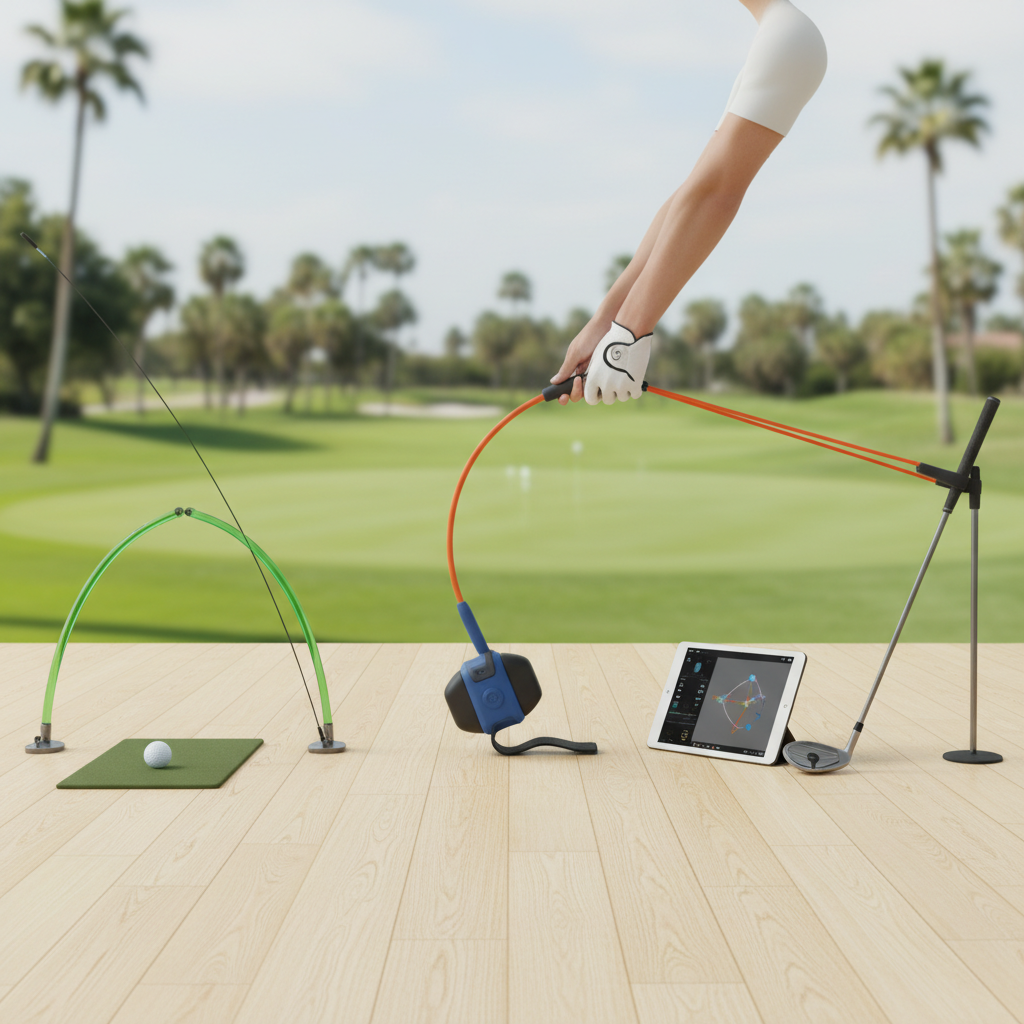
Types of Golf Swing Trainers and What They Improve
Improving your golf swing is a constant journey of refinement. While lessons and range time are essential, swing trainers provide targeted feedback to help you feel the correct movements and build muscle memory. These devices are designed to isolate and fix specific flaws, from an overly quick tempo to an incorrect swing path. Understanding what each type of trainer does can help you choose the right tool to work on your specific weaknesses this year.
1. Weighted Tempo and Rhythm Trainers
One of the most common flaws among amateur golfers is poor tempo. Rushing the transition from the backswing to the downswing throws off timing and leads to inconsistent strikes. Weighted tempo trainers, often characterized by a flexible shaft and a weighted head, are designed specifically to combat this issue. The design of these tools forces the golfer to make a smooth, unhurried backswing to allow the weighted head to "load" at the top. If you try to snatch the club down from the top too quickly, the flexible shaft will bend excessively, providing immediate feedback that your sequence is off.
By swinging this type of trainer, you learn to feel the momentum of the clubhead and wait for it at the top of the swing. This encourages a more patient transition and a downswing that starts from the ground up, using your lower body to initiate the movement. Regular use helps ingrain a smoother, more rhythmic swing that feels less like a frantic hit and more like a powerful, flowing motion. They also serve as an excellent warm-up tool before a round, helping to loosen up your muscles and find your rhythm for the day.
2. Swing Plane and Path Correctors
The path your club takes during the swing is critical for accuracy and solid contact. A swing that is too "over the top" (outside-to-in) often results in a slice, while a swing that is too "underneath" (inside-to-out) can lead to a hook. Swing plane correctors are aids that provide a physical guide for your club. These can range from simple alignment rods placed strategically in the ground to more complex hoop-like structures that you swing inside of. The goal is to give you a tangible reference for where the club should be at various points in the swing.
By forcing your club to follow the correct path, these trainers help you retrain your body to avoid common path errors. For example, if you tend to come over the top, you will physically bump into the guide, alerting you to the mistake instantly. This type of feedback is invaluable because it doesn't rely on you interpreting video or a coach's verbal cues; you can feel the mistake as it happens. Over time, practicing with these aids helps your body learn the sensation of a neutral, on-plane swing, making it more repeatable on the course.
3. Impact Position and Ball Striking Aids
A strong, consistent impact position is the secret to powerful and accurate golf shots. Many amateurs struggle with "scooping" the ball or "flipping" their wrists through impact, which adds loft and reduces compression. Impact trainers, such as specially designed impact bags, are built to help you feel what a solid impact should feel like. These are essentially durable, cushioned bags that you swing into, stopping your club at the moment of impact. The goal is to strike the bag with the clubface square and the shaft leaning forward toward the target.
Practicing with an impact bag teaches you to maintain a flat lead wrist and rotate your body through the shot, rather than relying on your hands to lift the ball. This promotes the feeling of compressing the golf ball against the clubface, which is the key to distance and control. Other trainers in this category might focus on keeping the clubhead low through the impact zone, ensuring you strike the ball first and then the turf, which is crucial for crisp iron play.
4. Wrist Angle and Hinge Guides
The role of the wrists in the golf swing is complex, and incorrect wrist angles can cause a host of problems, including an open or closed clubface. Wrist angle trainers are typically small devices that attach to your club or your wrist. They are designed to provide feedback on whether you are maintaining the correct wrist hinge throughout the swing. For example, some trainers will give you a "click" or rest against your forearm when you have achieved the proper amount of wrist set at the top of your backswing.
These aids are particularly useful for golfers who struggle with "cupping" their lead wrist (bending it backward) at the top, which often leads to an open clubface and a slice. By using a guide that promotes a flat or even slightly bowed lead wrist, you can train yourself to keep the clubface square or slightly closed, a position favored by many elite ball strikers. This helps ensure the clubface is delivered to the ball in a powerful and controlled manner, improving both direction and distance.
5. Body Rotation and Sequencing Tools
An efficient golf swing is a chain reaction, starting with the lower body and transferring energy up through the torso, arms, and finally to the club. This is known as the kinematic sequence. Many golfers, however, are "armsy," meaning their swing is dominated by their upper body, robbing them of potential power. Body rotation and sequencing trainers are designed to teach you how to use your whole body correctly. These aids can include resistance bands that connect to your body to encourage a proper turn or tools that help you feel the separation between your lower and upper body during the transition.
The primary benefit of these trainers is teaching you to generate power from your core and legs. By providing resistance or guidance, they force you to engage the bigger muscles, which are the true engine of the golf swing. This not only leads to more distance but also puts less strain on your arms and back, potentially reducing the risk of injury. Consistent practice with these tools helps build a more athletic and repeatable swing motion that is both powerful and efficient.
The Science Behind Effective Golf Practice Aids
The reason swing trainers can be so effective lies in the principles of motor learning and neuroplasticity. When you're trying to change a motion as complex as a golf swing, simply thinking about the new movement is often not enough. Your brain has already created strong neural pathways for your old, flawed swing. To overwrite these pathways, you need clear, immediate, and consistent feedback. This is precisely what a good training aid provides.
These tools work by enhancing what is known as kinesthetic feedback—your sense of body position and movement. Instead of just seeing a flaw on video (visual feedback) or hearing a coach describe it (auditory feedback), a swing trainer makes you feel the correct position or motion. When you bump into a swing plane guide or feel the resistance of a sequencing band, your brain receives a powerful, unmistakable signal. This repeated physical feedback helps accelerate the process of building new muscle memory, making the correct motion feel natural and automatic over time, which is the ultimate goal of any swing change.
Common Questions About Using Golf Swing Trainers
Can You Use Swing Trainers Indoors?
Absolutely, though it depends heavily on the specific type of trainer and your available space. Many of the most popular training aids are designed with indoor use in mind, making them perfect for off-season practice or for golfers who live in apartments. Putting aids, such as alignment mirrors and putting gates, require very little space and can be used on a carpet or a dedicated putting mat. Similarly, many wrist hinge guides and impact bags can be used indoors, provided you have enough room to make a slow, controlled motion without hitting anything.
However, trainers that require a full swing, like weighted tempo trainers or full-arc swing plane correctors, demand much more caution. You must have adequate ceiling height to ensure the club won't hit the ceiling at the top of your backswing. It's always best to take slow, deliberate practice swings first to gauge your clearance. For these larger-motion trainers, a garage, basement with high ceilings, or a backyard is often a much safer and more practical option than a typical living room.
How Often Should You Practice with a Swing Trainer?
When it comes to building new muscle memory, consistency trumps intensity. Long, grueling practice sessions with a training aid can sometimes be counterproductive, leading to fatigue and a breakdown in form. Instead, most experts recommend shorter, more frequent sessions. Integrating a swing trainer into your routine for just 10 to 15 minutes a day, five days a week, can be far more effective than a single two-hour session on the weekend.
A great way to incorporate a trainer is to use it as part of your warm-up. Before heading to the range or the first tee, spending five minutes with a tempo trainer can help groove your rhythm for the day. If you're working on a specific mechanical change, like your wrist position, making 20-30 slow-motion swings with the aid each evening can significantly accelerate your progress. The key is repetition and frequency, allowing your brain and body to gradually adopt the new movement until it becomes second nature.
Do Professional Golfers Use Swing Trainers?
Yes, professional golfers at the highest levels use swing trainers and practice aids constantly. While their choices might be more sophisticated, the underlying principle is the same: they use tools that provide precise feedback to maintain and fine-tune their mechanics. The most common aid you'll see on any professional practice range is a pair of alignment sticks. Pros use them for everything from aiming their body and clubface to creating a visual guide for their swing path.
Beyond simple sticks, many tour players work with advanced feedback systems like launch monitors (which are, in essence, the ultimate digital swing trainer) and 3D motion capture systems. They also use physical aids to work on specific feels, such as small, weighted balls to place between their forearms to promote a connected swing, or specialized bands to enhance their sense of rotation. For professionals, golf is a game of minuscule advantages, and using training aids helps them ensure every part of their swing is as efficient and repeatable as possible.
Conclusion
Golf swing trainers are valuable tools that can accelerate improvement by providing the tangible feedback needed to build correct muscle memory. Whether your goal is to smooth out your tempo, fix your slice, or develop a more powerful impact position, there is likely a training aid designed to help. The key is to first identify the primary weakness in your swing and then choose a trainer that specifically addresses that issue. By incorporating the right tool into a consistent practice routine, you can make meaningful and lasting improvements to your game this year.
For more insights into golf instruction and equipment, you can visit authoritative sources like Golf.com or the PGA of America's coaching resources.