Exploring the Effectiveness of Invisible Fences for Pet Containment
Invisible fences are a popular option, but the crucial question remains: do they actually work? To give you a clear answer, we’ll break down the technology, the key pros and cons you need to consider, and the critical role that proper training plays in their success.
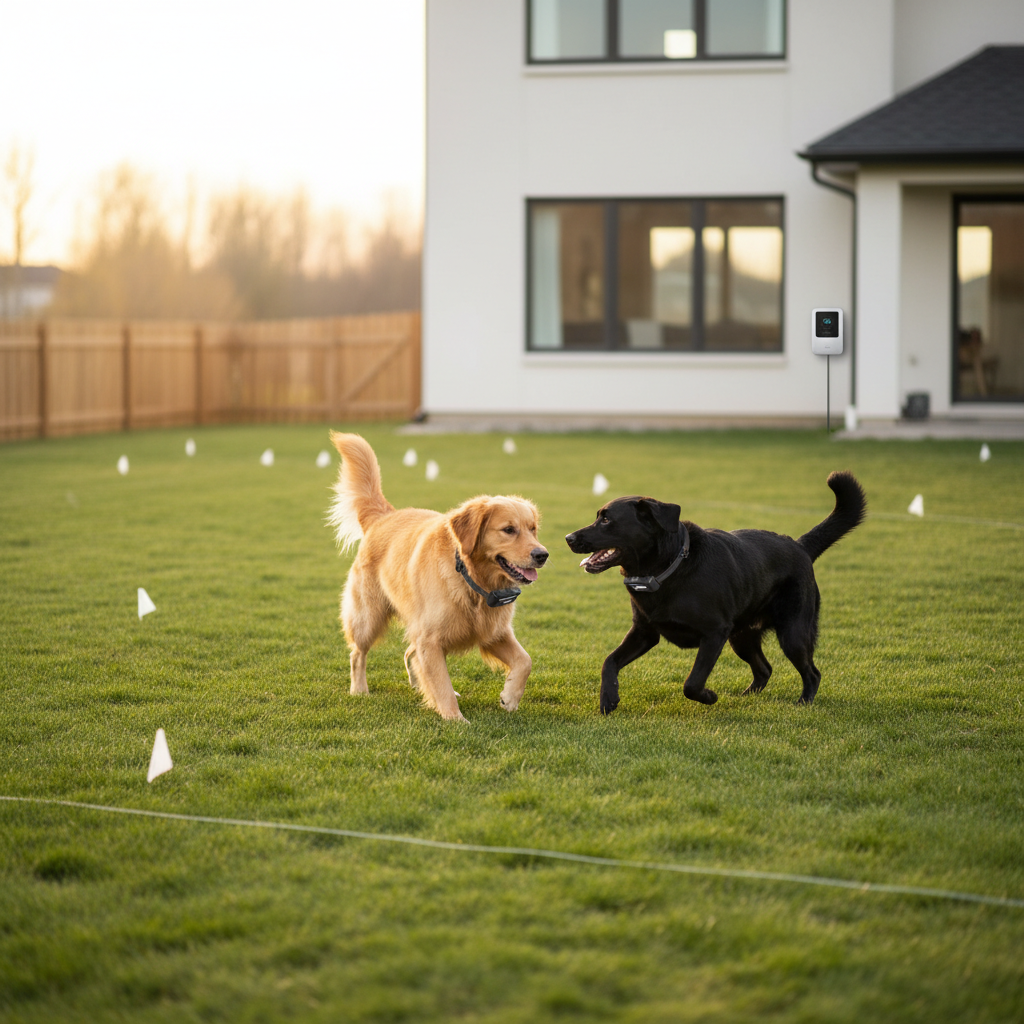
Understanding the Components of an Invisible Fence System
To understand how well an invisible fence works, it's essential to first grasp its core components. These systems are not just a single piece of technology but a trio of interconnected parts that work together to create a boundary. When properly installed and paired with consistent training, these components form an effective pet containment solution.
The Transmitter: The Brain of the Operation
The transmitter is the central control unit of the entire system. Typically installed in a dry, protected area like a garage or basement, this device is plugged into a standard electrical outlet. Its primary job is to send a low-frequency radio signal along the boundary wire. Most transmitters have adjustable settings that allow you to control the width of the boundary field—the area where your pet's collar will activate. This allows for customization based on your yard size and specific needs, such as creating a wider warning zone in some areas and a narrower one in others.
The Boundary Wire: Defining the Safe Zone
The boundary wire is a thin, insulated copper wire that you lay out to define the perimeter of your pet's safe area. This wire can be buried a few inches underground, attached to an existing physical fence, or even laid on the ground and secured with landscape staples. It must form a continuous, unbroken loop that starts and ends at the transmitter. The radio signal sent by the transmitter travels along this wire, creating the invisible boundary. This flexibility is a major advantage, as you can contour the wire around gardens, pools, and driveways, creating a custom-shaped containment area that traditional fences can't easily accommodate.
The Receiver Collar: The Communication Device
The receiver collar is worn by your pet and acts as the communication link between the boundary and your animal. This lightweight, battery-powered device is designed to detect the radio signal emitted by the boundary wire. When your pet approaches the wire, the collar enters the signal field and delivers a warning, which is typically an audible beep or a vibration. If the pet continues to move closer to the boundary, the collar will then administer a harmless but startling static correction. The intensity of this correction is usually adjustable, allowing you to find a level that is effective for your pet's size and temperament without causing harm.
The Crucial Role of Training in Effectiveness
An invisible fence is not a "plug-and-play" solution. Its success is almost entirely dependent on proper, patient, and consistent training. The goal of training is not to scare the pet but to teach them to recognize and respect the new boundary. Without this crucial step, the system is likely to fail, leading to confusion for the pet and frustration for the owner.
The training process typically begins with placing visual flags along the buried wire. These flags provide a physical cue that helps your pet associate the warning beep from their collar with a specific location. During the first week or two, you will walk your leashed pet around the perimeter, allowing them to hear the warning tone when they get near the flags. This phase is about association, not correction. You use positive reinforcement, like treats and praise, to reward them for turning back into the "safe" zone.
Only after the pet understands the meaning of the warning beep is the static correction introduced, usually at the lowest effective level. The training continues with controlled distractions to teach the pet to respect the boundary even when tempted by squirrels, other dogs, or passersby. The entire process requires patience and repetition, reinforcing the boundary rules until they become second nature for your pet. Rushing this process is the most common reason for failure.
Factors That Influence the Success of an Invisible Fence
While the technology is sound, several factors can influence how well an invisible fence contains a specific pet. A successful outcome depends on a combination of the pet's personality, the owner's commitment, and the system's upkeep.
Your Pet's Temperament and Breed
A pet's individual personality plays a massive role. A timid or sensitive dog may learn the boundary very quickly with minimal correction. Conversely, a dog with an extremely high prey drive (like a terrier or a hound) or a very determined, high-energy personality might be more willing to endure the momentary static correction if the temptation—like a squirrel or a cat across the street—is strong enough. Breed-specific traits can matter, but individual temperament is often the more significant factor.
Consistency in Training
As mentioned, training is paramount. The owner's commitment to following the training protocol without skipping steps is critical. Short, frequent, and positive training sessions are far more effective than long, infrequent ones. Every family member should be on the same page about the rules to avoid confusing the pet. Consistency reinforces the learning process and builds the pet's confidence within their designated safe area.
Proper Installation and Maintenance
A poorly installed system will yield poor results. Wire breaks are a common issue, which can create "dead zones" in the boundary where a pet can escape without any warning or correction. It's important to know the path of your wire to avoid damaging it during landscaping or yard work. Furthermore, the receiver collar requires regular maintenance. The battery must be checked and replaced periodically, as a dead battery renders the entire system useless. The collar must also fit properly—snug enough to ensure the contact points touch the skin, but not so tight as to be uncomfortable.
The Science Behind Pet Containment Systems
The technology behind invisible fences is rooted in a well-established psychological principle known as operant conditioning. This form of learning uses consequences to modify the form and occurrence of behavior. In this case, the system uses a combination of cues and deterrents to teach an animal to stay within a specific area.
The process begins with an auditory cue—the warning beep from the collar. Through initial training with flags, the pet learns to associate this specific sound with their proximity to the boundary. This is a form of classical conditioning, similar to how Pavlov's dogs learned to associate a bell with food. Here, the pet learns to associate the beep with the boundary line. The consequence for ignoring this warning beep is an aversive stimulus: the static correction. This is an example of positive punishment (in the behavioral science sense, meaning adding a stimulus to decrease a behavior), where the unpleasant sensation discourages the pet from crossing the boundary.
Crucially, the system is also designed to leverage negative reinforcement—the removal of an unpleasant stimulus to encourage a behavior. When the pet hears the beep and retreats from the boundary, the unpleasant sound stops. This rewarding outcome reinforces the act of turning back into the safe zone. When combined with positive reinforcement from the owner (praise, treats for staying in the yard), the pet quickly learns that good things happen inside the boundary and unpleasant things happen at the edge, making the choice to stay inside a self-motivated one.
Common Questions About Invisible Fence Reliability
Even with proper training, pet owners often have lingering questions about the real-world reliability and application of these systems. Understanding the potential limitations is just as important as knowing the benefits.
Can a Dog Run Through an Invisible Fence?
Yes, it is possible for a dog to run through an invisible fence. This is often referred to as a "breakthrough." It typically happens when the dog's motivation to leave the yard is extraordinarily high, overpowering its aversion to the static correction. A surge of adrenaline, triggered by seeing another animal, a stranger, or a car backfiring, can numb the dog to the sensation of the correction long enough for it to cross the boundary.
The bigger issue with a breakthrough is that once the dog is outside the safe zone, it may be hesitant to re-enter. The system works in both directions, so to get back in, the dog would have to experience the same static correction again. This can lead to a dog being "stuck" outside its own yard. This risk can be minimized by ensuring the correction level is appropriate for your dog's temperament (not too low) and by conducting thorough training with high-level distractions to prepare them for real-world scenarios.
Do Invisible Fences Work for Cats?
Many companies offer invisible fence systems designed specifically for cats, and they can be effective for some felines. However, containing a cat presents unique challenges. Cats are natural climbers and jumpers, and an invisible fence on the ground won't stop a cat from climbing a tree or fence and leaving the yard from above. Training a cat also requires a different approach than training a dog, demanding even more patience and a deep understanding of feline behavior.
For cat containment, these systems are often most successful when used to keep a cat within an already partially enclosed area, like a securely fenced backyard, preventing them from digging under or jumping over. They can also be used to keep cats out of specific areas, such as gardens or sandboxes. Success heavily depends on the individual cat's personality; a determined and agile explorer may prove more difficult to contain than a more laid-back homebody.
Are There Alternatives to Invisible Fences?
Absolutely. The most obvious alternative is a traditional physical fence, such as wood, vinyl, or chain-link. A physical barrier provides a clear visual and physical boundary that not only keeps your pet in but also keeps other animals and people out—something an invisible fence cannot do. However, physical fences are often more expensive and may be prohibited by homeowner associations.
For smaller areas, a dog run or kennel can provide a secure space for your pet to enjoy the outdoors under supervision. A simple tie-out or trolley system can also work for short periods, but pets should never be left unattended on them due to risks of tangling and injury. More recently, GPS-based "virtual" fences have emerged. These systems use GPS technology to create boundaries without any wires and alert the owner via a smartphone app if the pet leaves the designated area, though the boundary lines are often less precise than a wired system.
Conclusion
So, how well do invisible fences contain pets? The answer is that they can be extremely effective, but their success is not guaranteed by the technology alone. An invisible fence is a tool for behavioral training, not a foolproof force field. Its effectiveness is directly tied to the quality of the installation, the consistency of the training protocol, and the individual temperament of the pet. When owners invest the time to teach their pets to understand and respect the boundary, an invisible fence can provide a safe and reliable way to give their furry companions freedom and security.