Exploring the Pros and Cons of Starlink: Is It the Right Internet Provider for You?
You’re asking the big question: Is Starlink actually the best internet provider available today? With all the buzz around satellite internet, it's a valid one.
Understanding Starlink's Unique Position in the Market
Before deciding if Starlink is the "best," it's crucial to understand what it is and who it’s for. Starlink is a satellite internet service developed by SpaceX, designed to deliver high-speed, low-latency internet to virtually anywhere on the planet. Unlike traditional internet providers that rely on physical cables, Starlink uses a massive constellation of satellites in Low Earth Orbit (LEO) to beam internet service directly to a user's terminal, often called a "dishy."
Its primary mission is to solve the connectivity problem for rural, remote, and underserved communities. For millions of people, the only options have been slow DSL, unreliable fixed wireless, or traditional satellite internet with cripplingly high latency. Starlink enters the market not just as another option, but as a revolutionary solution for a specific, yet massive, audience. Therefore, its "best" status is highly dependent on your location and existing internet options.
Key Factors to Consider: A Deep Dive into Starlink's Features
To properly evaluate Starlink, we need to break down its core components: speed, availability, cost, and ease of use. These factors determine its real-world performance and value proposition compared to other internet service providers (ISPs).
Speed and Latency
This is where Starlink dramatically separates itself from old satellite technology. Standard residential users can typically expect download speeds ranging from 50 to 250 Mbps and upload speeds between 10 and 20 Mbps. While this might not beat the top-tier gigabit fiber plans in a city, it far exceeds what is typically available in rural areas.
Even more important is the latency—the time it takes for data to travel from your device to a server and back. Traditional satellite internet has latency upwards of 600ms, making activities like video calls, online gaming, and even snappy web browsing nearly impossible. Because Starlink's satellites are in a low orbit, its latency is typically between 20ms and 40ms, which is on par with ground-based connections like cable and fiber. This single factor makes the online experience feel responsive and modern.
Global Availability and Portability
Starlink's biggest strength is its reach. Since it doesn't rely on laying thousands of miles of cable, it can provide service to mountaintops, remote farms, and isolated communities where traditional ISPs have no financial incentive to build infrastructure. As long as you have a clear view of the sky, you can likely get a connection. This makes it an invaluable tool for people who have been left behind by the digital divide.
Furthermore, Starlink offers portability plans for users on the move. The "Roam" (formerly RV) plan allows users to take their dish with them in their camper, boat, or vehicle, providing high-speed internet in campgrounds, marinas, and remote work locations. This flexibility is something that no fixed-line internet provider can offer.
The Cost of Entry and Subscription
Starlink's cutting-edge technology comes at a premium. The initial hurdle is the one-time hardware cost for the satellite dish and router, which can be several hundred dollars. After that, the monthly subscription fee for the standard residential plan is often higher than introductory offers from cable or fiber companies. For those in urban areas, this cost can make it less competitive.
However, for its target audience in rural areas, this price is often seen as a reasonable investment. When the alternative is an unusable 3 Mbps DSL line for a similar monthly price, the value proposition of Starlink becomes incredibly compelling. The cost is relative to the quality and availability of other options.
Installation and Setup
Starlink is designed for a simple, do-it-yourself setup. The kit arrives with the dish (nicknamed "Dishy"), a tripod mount, a router, and cables. The process involves placing the dish in a location with an unobstructed view of the sky, plugging it in, and connecting to the Wi-Fi network. An app guides you through finding the optimal placement and monitoring the connection. Most users can be online within 30 minutes, without needing to schedule a technician visit.
How Starlink Stacks Up: A Comparison with Traditional Internet
The question of whether Starlink is the "best" can only be answered by comparing it directly to the alternatives. For most people, the choice comes down to Starlink, Fiber Optic, Cable, DSL, or 5G Home Internet.
| Feature | Starlink | Fiber Optic | Cable | DSL | 5G Home Internet |
|---|---|---|---|---|---|
| Avg. Download Speed | 50 - 250 Mbps | 250 Mbps - 5 Gbps | 100 - 1000 Mbps | 5 - 100 Mbps | 50 - 300 Mbps |
| Avg. Latency | 20 - 40 ms | < 20 ms | 20 - 40 ms | 30 - 100 ms | 30 - 50 ms |
| Availability | Global (Rural Focus) | Limited (Urban/Suburban) | Wide (Urban/Suburban) | Very Wide (Incl. Rural) | Growing (Urban/Suburban) |
| Typical Cost | High (Hardware + Monthly) | Moderate | Low to Moderate | Low | Low to Moderate |
| Reliability | Good (Weather Dependent) | Excellent | Very Good | Fair to Good | Good (Signal Dependent) |
When Starlink Wins
Starlink is the undisputed champion in areas with no access to fiber or high-speed cable. For anyone stuck on slow DSL or traditional satellite, Starlink is not just a better option; it's a transformative one. It brings modern internet speeds to places that have been overlooked for decades, enabling remote work, online education, and high-quality entertainment.
When Traditional Providers Are Better
If you live in a city or suburb with access to a fiber optic network, that will almost always be the superior choice. Fiber typically offers faster, more consistent speeds (especially for uploads), lower latency, and superior reliability for a lower monthly cost and no upfront hardware fee. Similarly, high-speed cable internet often provides a better price-to-performance ratio in areas where it is available.
The Technology Behind Starlink: A Revolution in Satellite Internet
To appreciate Starlink's impact, it helps to understand the leap in technology it represents. For decades, satellite internet relied on a few very large satellites in geostationary (GEO) orbit, about 22,000 miles above the Earth. Because they were so far away, the time it took for a signal to travel to the satellite and back (latency) was extremely high. This delay made real-time applications feel sluggish and frustrating.
Starlink's innovation was to use thousands of smaller, cheaper satellites in Low Earth Orbit (LEO), only about 340 miles up. This drastically reduces the physical distance the signal must travel, slashing latency to levels comparable with ground-based internet. These satellites work together as a "constellation," handing off the signal from one to the next as they fly overhead, ensuring a continuous and stable connection for the user on the ground.
Common Questions About Starlink's Performance
Potential users often have practical questions about how Starlink performs in day-to-day scenarios. Here are some of the most common inquiries.
How Does Weather Affect Starlink?
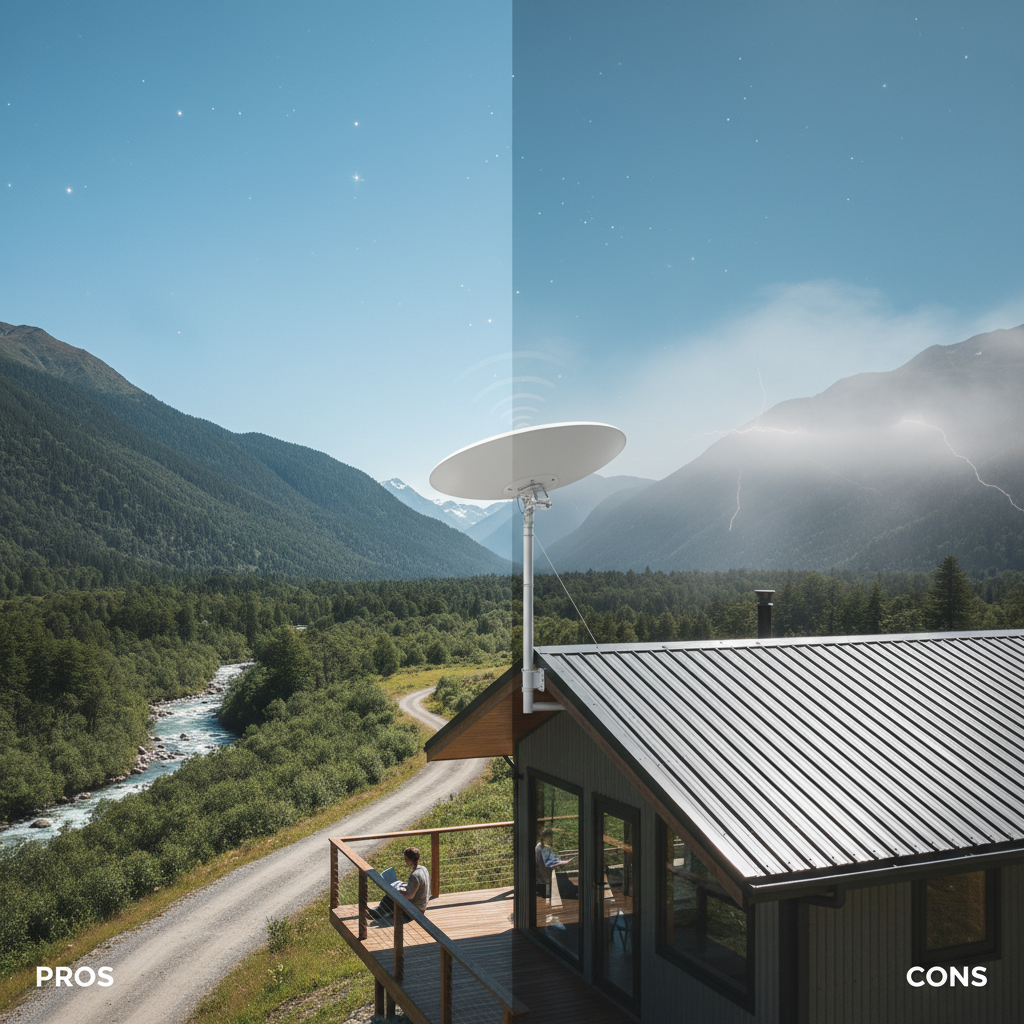
Like any satellite-based service, Starlink can be affected by atmospheric conditions. Very heavy rain, thick wet snow, or extremely dense storm clouds can interfere with the signal, potentially causing slowdowns or brief outages. This phenomenon is known as "rain fade."
However, Starlink is engineered to be resilient. The dish has a built-in heater to melt snow and ice, which can be a major advantage in winter climates. For most typical weather events, users report little to no impact on their service. The interruptions are generally infrequent and short-lived, but it is a factor to consider compared to the near-total immunity of a buried fiber optic cable.
Can You Use Starlink for Gaming and Streaming?
Absolutely. For streaming, Starlink's speeds are more than sufficient to handle multiple 4K video streams simultaneously without buffering. It provides a premium streaming experience that was previously unimaginable on satellite internet. This opens up services like Netflix, Hulu, and YouTube TV to a whole new customer base.
For gaming, the low latency is the key. With latency in the 20-40ms range, Starlink is perfectly suitable for most online multiplayer games, including fast-paced shooters and strategy games. While a dedicated fiber line might provide a slight edge for professional, competitive gamers, the vast majority of players will find the Starlink experience to be excellent and responsive.
What Is the Future of Starlink?
Starlink is a constantly evolving project. SpaceX is continuously launching new satellites to expand the constellation's capacity, improve speeds, and reduce the potential for network congestion. This means the service is likely to get even better and more reliable over time as more satellites come online.
The company is also working on next-generation hardware, including smaller, more portable terminals. Furthermore, Starlink is developing a "Direct to Cell" service, which aims to provide basic text, voice, and data connectivity directly to standard smartphones, eliminating mobile dead zones across the globe. This shows a long-term vision far beyond just being a home internet provider.
Conclusion: The Verdict on Starlink
So, is Starlink the best internet provider? The answer is a classic "it depends." It is not objectively the best for everyone in every situation. An urban resident with access to gigabit fiber for half the price would have no reason to choose Starlink. In that scenario, fiber is unequivocally the superior option.
However, for its target market—the tens of millions of people in rural and remote areas—Starlink is arguably the best internet provider to have ever existed. It is a revolutionary, game-changing service that delivers on its promise of bringing fast, usable internet to the unconnected. For this massive group of users, Starlink isn't just the best option; it's often the only one.
For more information, you can visit the official Starlink website or read in-depth reviews on technology sites like PCMag.