Integrating Cable Machines into Your Home Gym: Versatile Options for Every Space
A cable machine can be a game-changer for a home gym, but its true value depends on how it fits into your specific setup. Whether you’re building out a full garage gym, converting a spare bedroom, or maximizing a small apartment corner, the right choice isn't always obvious.
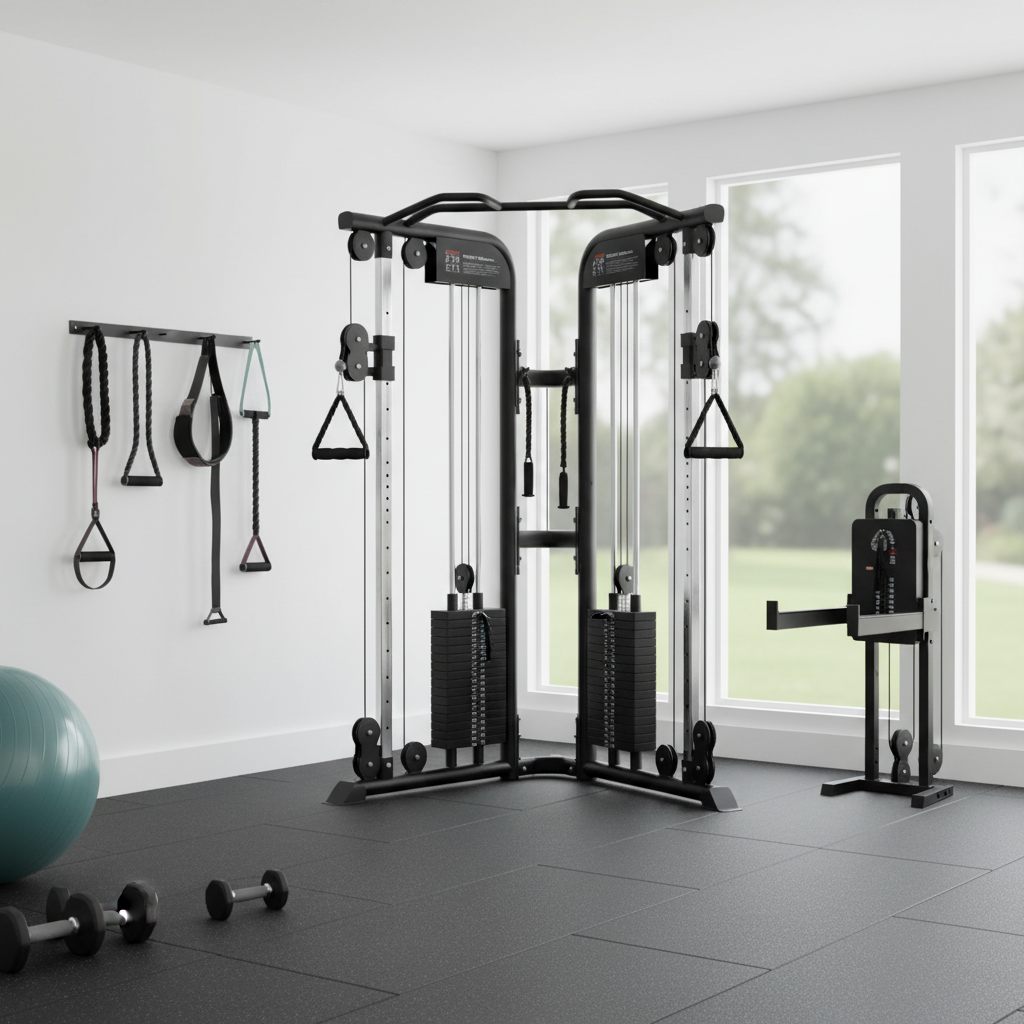
Cable Machines in Various Home Gym Contexts
A cable machine is one of the most versatile pieces of equipment you can add to a home gym. Unlike free weights, which rely solely on gravity, cable systems use pulleys and weight stacks to provide constant tension throughout an exercise's full range of motion. This unique characteristic allows them to adapt to nearly any fitness goal or space constraint. How one fits into your specific setup, however, depends entirely on what you're trying to achieve.
Below, we explore how cable machines integrate into four common types of home gyms, from the smallest apartment corner to a fully equipped garage powerlifting haven.
1. For the Minimalist or Small-Space Gym
Living in an apartment or having only a small spare room doesn't exclude you from the benefits of a cable machine. In this scenario, the goal is maximum functionality in a minimal footprint. Compact, wall-mounted functional trainers or single-stack cable columns are ideal solutions. These units anchor directly to the wall, consuming very little floor space while offering incredible exercise variety. A single adjustable pulley can be used for bicep curls, tricep pushdowns, lateral raises, face pulls, and core exercises like wood chops.
The primary advantage here is consolidation. Instead of needing a rack of dumbbells, multiple resistance bands, and other standalone items, a single cable column can effectively replace them all. This not only saves space but also streamlines your workout, allowing you to transition between exercises quickly. For those focused on general fitness, toning, and rehabilitation, a compact cable system can serve as the centerpiece of their entire home gym, providing a full-body workout without the clutter.
2. For the Powerlifter's Garage Gym
At first glance, a cable machine might seem out of place in a garage gym dominated by a power rack, barbells, and hundreds of pounds of iron plates. The core focus here is on the "big three" lifts: squat, bench press, and deadlift. However, a cable machine is the perfect complementary tool for the serious strength athlete. It excels at accessory work—the secondary exercises that build up supporting muscles, address weaknesses, and prevent injury.
After a heavy session of bench pressing, for example, a powerlifter can use a cable machine for tricep pushdowns to build lockout strength or cable flys to isolate the pectoral muscles without stressing the joints. Lat pulldowns and seated rows are crucial for developing back strength to support heavy deadlifts. Furthermore, cables are invaluable for "prehab" and rehab exercises, like face pulls for shoulder health, which are difficult to replicate effectively with free weights. In this setup, the cable machine isn't the star of the show; it's the essential supporting actor that ensures longevity and balanced muscular development.
3. For the All-in-One Family Fitness Room
When a home gym needs to cater to multiple users with different fitness levels, goals, and ages, safety and accessibility become top priorities. This is where a robust functional trainer with dual weight stacks truly shines. Unlike free weights, which can be intimidating and carry a higher risk of injury if used with improper form, selectorized cable machines are incredibly user-friendly. Changing the weight is as simple as moving a pin, eliminating the need to load and unload heavy plates.
The adjustable pulleys can be set at any height, accommodating everyone from a tall adult to a teenager just starting their fitness journey. One person can be doing chest presses while another focuses on leg kickbacks. This versatility makes it a central hub for family fitness. The smooth, controlled motion is also excellent for older individuals or those recovering from an injury, providing a safe way to build strength. It offers a comprehensive workout solution that everyone in the household can use comfortably and safely.
4. For the Bodybuilding-Focused Home Gym
For the home gym user focused on aesthetics and muscle hypertrophy (growth), the cable machine is an indispensable centerpiece. Bodybuilding is built on the principle of isolating specific muscles and maximizing time under tension, and no other piece of equipment does this better than a cable machine. The constant resistance provided by the weight stack ensures that the target muscle is working throughout the entire lift, from start to finish. This is a significant advantage over dumbbells, where tension can drop off at the top or bottom of the movement.
Exercises like cable crossovers allow for a deep stretch and powerful contraction of the chest muscles that is difficult to match with a barbell press. Cable lateral raises keep constant tension on the deltoids to build broad shoulders, while various curls and pushdowns can target the biceps and triceps from unique angles. The ability to perform drop sets is another huge benefit; you can quickly reduce the weight by moving the pin, allowing you to push muscles past their point of initial failure to stimulate further growth. In this gym, the cable machine is a primary tool for sculpting and refining the physique.
The Versatility of Constant Tension: Why Cables are Unique
To truly understand why cable machines are so adaptable, it’s important to grasp the core principle that sets them apart from free weights: constant tension. When you lift a dumbbell or barbell, you are working directly against gravity. The resistance you feel changes depending on the angle of your limbs relative to the floor. For example, during a dumbbell bicep curl, the tension is greatest when your forearm is parallel to the floor (the halfway point) and significantly less at the very bottom and very top of the movement. This creates a "strength curve" with a clear sticking point.
Cable machines defy this limitation. Because the resistance comes from a weighted stack moving up and down on guide rods, the tension on the cable remains constant regardless of the angle of the pull. Whether you are at the beginning, middle, or end of a tricep pushdown, the weight feels the same. This constant time under tension is a powerful stimulus for muscle growth. It forces the muscle to work harder throughout every inch of the movement, leading to greater metabolic stress and muscle fiber recruitment. This unique feature is what makes cables so effective for both isolation exercises in bodybuilding and for functional movements that mimic real-world activities.
Common Questions About Integrating a Cable Machine
What's the Difference Between Functional Trainers and Single-Stack Cable Machines?
While often used interchangeably, there's a key distinction between these two types of machines. A single-stack machine, or a cable column, typically has one weight stack and one or two pulley points (often a high and a low one). Some models have a single adjustable pulley. They are generally more compact and affordable, making them great for smaller spaces or as an addition to an existing gym for specific exercises like lat pulldowns or tricep extensions.
A functional trainer is a more comprehensive unit. Its defining feature is two independent weight stacks and two widely spaced, fully adjustable pulley systems. This dual-pulley design unlocks a vast range of new exercises. It allows for bilateral movements (like a chest press) and unilateral movements (working one arm or leg at a time), which is excellent for correcting muscle imbalances. The ability to position the pulleys both vertically and horizontally provides nearly limitless angles for pulling and pressing, making it the most versatile option for a full-body workout.
Can Cable Machines Replace Free Weights Completely?
This is a common question with a nuanced answer. For the average person whose goal is general health, functional strength, and building a lean physique, a high-quality functional trainer can absolutely serve as the foundation of their entire routine. It offers a safer, more controlled environment and can replicate hundreds of exercises. For rehabilitation, senior fitness, and anyone hesitant to use heavy barbells, a cable machine is a superior choice.
However, for those whose primary goal is developing maximal strength and power—such as powerlifters or competitive athletes—free weights remain essential. Heavy, compound barbell movements like squats and deadlifts are unparalleled for stimulating the central nervous system, improving bone density, and building raw, foundational strength. The instability of free weights also forces stabilizer muscles to work harder. The ideal scenario for most serious lifters is not to choose one over the other, but to use them together. Use free weights for heavy compound lifts and use cables for isolation, accessory work, and functional movements.
How Much Space Do You Really Need for a Cable Machine?
The space requirement varies significantly by model, so measuring your area is critical before making a purchase. A wall-mounted single pulley system might only need a few feet of wall width and protrude less than a foot, but you'll need at least 5-6 feet of open space in front of it to perform exercises. Ceiling height is also a major factor, as most machines stand between 80 and 90 inches (about 7 to 7.5 feet) tall. You'll want at least a few inches of clearance above that.
A freestanding functional trainer requires the most space. The machine's footprint itself can be around 6 feet wide and 4 feet deep. More importantly, you need to account for "operational space." For exercises like cable flys or crossovers where you extend your arms out to the sides, you'll need several feet of clearance on either side of the machine. A safe estimate is to have a dedicated area of at least 10 feet wide by 8 feet deep to use a functional trainer comfortably and effectively.
Conclusion
A cable machine is far more than just a single piece of equipment; it's a versatile training system that can be tailored to almost any home gym environment. For the minimalist, it offers a space-saving, all-in-one solution. For the powerlifter, it's the perfect tool for targeted accessory work and injury prevention. In a family setting, it provides a safe and accessible option for users of all levels, while for the bodybuilder, it is the ultimate machine for muscle isolation and hypertrophy. By understanding your own fitness goals and spatial constraints, you can determine exactly how a cable machine can best fit into—and elevate—your personal workout space.