Why Choose a File Folder Organizer Over Traditional Drawers for Your Office
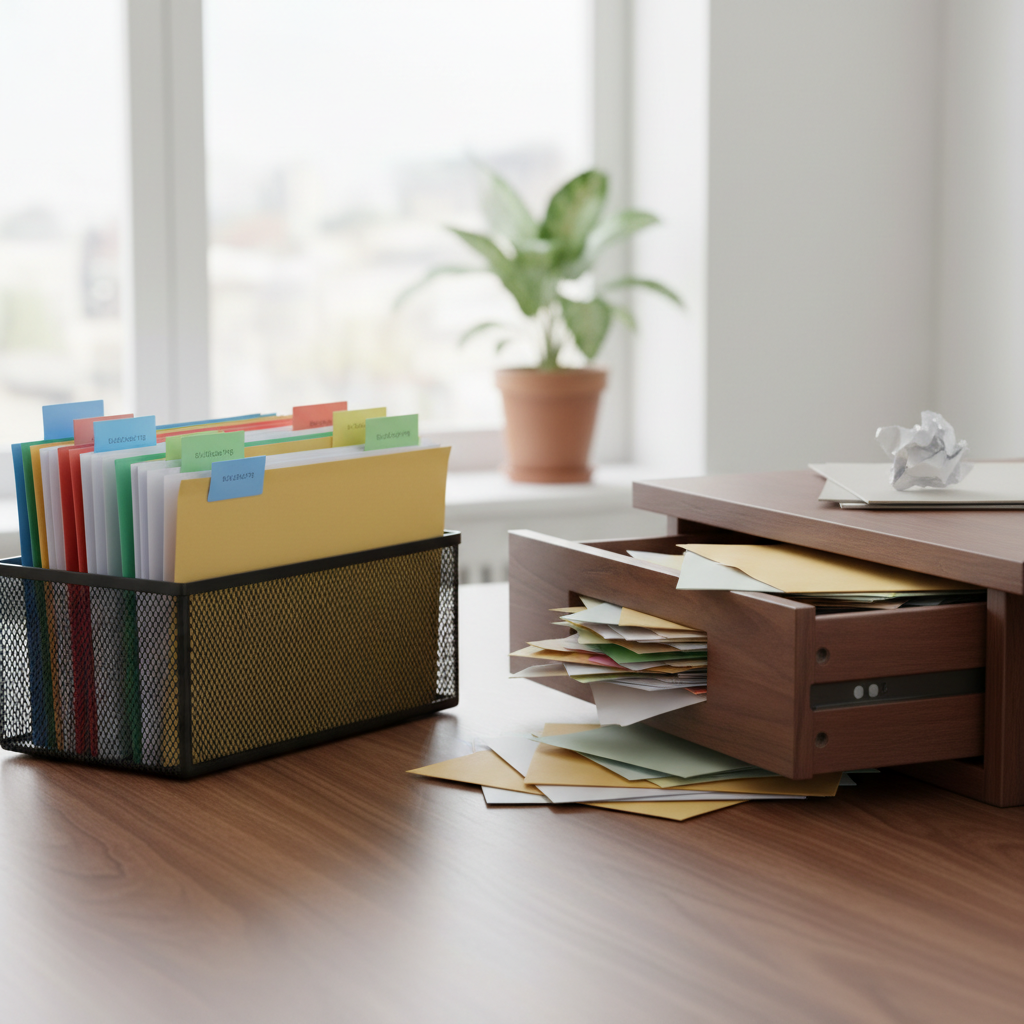
Drawers might seem like the go-to for filing, but they aren't always the most efficient choice for every task. A dedicated file folder organizer often works better, especially when you're dealing with active projects, limited desk space, or the need to grab your documents and go.
Understanding Traditional Filing Drawers
For decades, the filing drawer—most often as part of a larger filing cabinet—has been the undisputed champion of office organization. These sturdy, often metal, units are built for one primary purpose: to store large volumes of paper documents in a secure, systematic, and long-term manner. Typically designed to hold either letter or legal-sized hanging folders, drawers allow for a high-density storage solution. You can fit hundreds, if not thousands, of pages into a single cabinet, neatly tucked away from view.
The primary advantage of filing drawers is their sheer capacity and durability. They are the workhorses of document storage, ideal for archiving records, financial statements, client files, and any other paperwork that must be retained but isn't needed on a daily basis. Their enclosed nature also offers a level of protection from dust, light, and casual spills. Many models come with locks, providing an essential layer of security for confidential or sensitive information. However, this robust design comes with drawbacks. Filing cabinets are heavy, bulky, and largely immobile. They demand significant floor space and are not suited for documents that need to be accessed frequently or transported between locations.
The Rise of the File Folder Organizer
A file folder organizer represents a more modern, flexible approach to paper management. Unlike a rigid drawer, an organizer is designed for accessibility and portability. These tools come in a wide variety of forms, including desktop tiered organizers, portable accordion files, wall-mounted pockets, and stackable document trays. Their core function is not long-term archival but rather the management of active, in-progress, or frequently referenced documents. Think of them as a command center for your current projects, incoming mail, and immediate to-do lists.
The key benefit of a file folder organizer is its immediacy. It keeps important papers visible and within arm's reach, reducing the friction of having to open a heavy drawer every time you need a document. Portable versions, like accordion files, are perfect for professionals who move between home and office or need to bring materials to meetings. Wall-mounted organizers are excellent space-savers in smaller offices or homes. While they can't match the sheer volume of a filing cabinet, their strength lies in their adaptability, lower cost, and focus on streamlining daily workflow rather than deep storage.
Direct Comparison: Organizer vs. Drawers
Choosing between a file folder organizer and a set of drawers depends entirely on the job at hand. One is not inherently better than the other; they are simply different tools for different organizational tasks. The following table breaks down their core differences to help clarify which solution is best suited for various needs.
| Feature | File Folder Organizer | Filing Drawers |
|---|---|---|
| Primary Use Case | Managing active, daily, or short-term project files. | Long-term archival, high-volume storage, and securing sensitive documents. |
| Accessibility | High. Documents are typically open, visible, and within arm's reach. | Moderate to Low. Requires opening a drawer and searching through hanging files. |
| Portability | Excellent. Many types are specifically designed to be carried (e.g., accordion files). | Extremely poor. Filing cabinets are heavy, bulky, and stationary. |
| Space Efficiency | Very good for small spaces. Uses desktop, wall, or shelf space efficiently. | Requires significant, dedicated floor space. |
| Storage Capacity | Low to moderate. Designed for a limited number of active files. | High to very high. Can store thousands of documents in a compact footprint. |
| Security | Minimal. Most organizers are open and do not offer locking features. | Good to Excellent. Enclosed design protects papers, and many models include locks. |
| Cost | Generally low. Simple organizers are very affordable. | Moderate to high. A quality filing cabinet is a significant furniture investment. |
The Evolution of Paper Management in the Modern Office
The way we handle paper has undergone a dramatic transformation over the last century. The story begins with the invention of the vertical filing cabinet, patented in the late 1800s. This innovation revolutionized office work by allowing documents to be stored upright and indexed, making retrieval far more efficient than the previous method of flat-stacking papers in pigeonholes or chests. For nearly a hundred years, the metal filing cabinet was the unshakeable symbol of a well-run office, its drawers holding the collected knowledge and history of a business.
The digital revolution of the late 20th century began to challenge this paper-centric world. The promise of the "paperless office" suggested that filing cabinets would become obsolete relics. While that prediction hasn't fully come to pass, the role of physical paper has certainly changed. We now operate in a hybrid environment. Digital files handle much of the day-to-day communication and data storage, but paper persists for contracts, invoices, original records, and quick notes. This shift created a need for new organizational tools—ones that were less about permanent archival and more about managing the flow of the remaining physical documents. This is the exact niche that the modern file folder organizer so effectively fills, acting as a bridge between our digital workflows and the tangible papers we still rely on.
Addressing Common Organizational Challenges
Even with the right tools, keeping paperwork in order can be a challenge. Understanding a few core principles and addressing common questions can make the process much smoother, whether you choose drawers, organizers, or a combination of both.
How do you organize files without a filing cabinet?
For those with limited space or a smaller volume of paper, a filing cabinet can be overkill. Fortunately, there are many effective alternatives. The most direct replacement is a portable file box, which is essentially a single, lidded "drawer" that can hold hanging folders and be stored on a shelf or in a closet. This provides the same filing methodology without the bulky furniture.
For even smaller needs, binders can be a fantastic solution. By using a three-hole punch and divider tabs, you can create dedicated binders for different categories like "Household Bills," "Medical Records," or "Car Maintenance." This keeps related documents physically bound together. Lastly, file folder organizers, particularly desktop and wall-mounted versions, are a primary tool for managing day-to-day papers without a cabinet. They create a system of "in" and "out" trays or labeled slots for current projects, action items, and mail.
What is the best way to categorize files for easy access?
The effectiveness of any filing system, digital or physical, hinges on the logic of its categorization. The "best" method depends on how you think and what kind of information you're storing. The most common system is alphabetical, which is straightforward and works well for client files, employee records, or any topic sorted by name.
Another popular method is categorical or subject-based. This involves creating broad categories (e.g., "Finances," "Insurance," "Projects") and then using sub-folders for more specific topics within them (e.g., "Taxes 2023," "Homeowners Insurance," "Project Alpha"). For time-sensitive documents like invoices or reports, a chronological system (sorted by year, then month, then day) is often the most logical. Finally, some systems rely on numerical or color-coded indexing, which can be highly efficient for large volumes of files but requires a key or index to be effective.
Can digital and physical filing systems work together?
Absolutely. In fact, a hybrid approach is often the most practical and resilient system for the modern world. The key is to establish clear rules for what stays physical and what goes digital. For example, you might decide to scan all incoming bills and receipts for digital archival, while keeping the physical copies of critical, hard-to-replace documents like birth certificates, property deeds, and signed contracts in a secure physical location.
This hybrid model allows you to leverage the strengths of both worlds. Digital files offer unparalleled searchability, easy sharing, and remote access via cloud storage. Physical files provide a tangible backup and are essential for documents that require an original "wet" signature. You can use a file folder organizer to manage papers that are in the queue to be scanned, and a filing drawer to securely archive the critical originals once the digital copies are safely stored and backed up.
Conclusion
The choice between a file folder organizer and a set of filing drawers is not a matter of which is superior, but which is appropriate for the task. Filing drawers remain the best solution for high-volume, long-term archival and the secure storage of sensitive documents. They are the bedrock of a comprehensive record-keeping system.
A file folder organizer, in its many forms, excels in the realm of active, daily paper management. It prioritizes accessibility, portability, and workflow efficiency, making it the ideal tool for managing current projects, incoming mail, and frequently referenced materials. For most people, the optimal solution involves using both: an organizer on the desk for what's happening now, and a filing cabinet for what needs to be saved for later.