Achieving the Perfect Fit: A Guide to Accurately Measuring Your Bra Size at Home
Discover how you can measure your bra size at home accurately! Finding the perfect fit is key to comfort and style. Our guide offers practical tips on how to measure your bra size using simple household items. Learn what measurements matter most and gain confidence in your selections.
Why Accurate Bra Measurement Matters
Finding the perfect bra size can be more challenging than it seems. According to recent research from 2026, about 64% of women wear the wrong bra size, leading to discomfort and health issues such as back pain, skin irritation, and poor posture [source]. Understanding how to measure your bra size at home can save you from these issues and offer more comfort and confidence in everyday wear.
Beyond just physical comfort, wearing the right bra size can improve your outfit's fit and appearance. An accurate measurement ensures your bra provides the intended support and shape, enhancing your overall silhouette. In this article, we'll guide you through measuring your bra size at home for a perfect fit.
The Essential Tools for Measuring Your Bra Size at Home
Before we delve into the process, ensure you have the necessary tools at hand:
- Soft Measuring Tape: This will help you take precise measurements without compression.
- Mirror: A full-length mirror can help you ensure that the tape measure is correctly positioned.
- Pen and Paper: Use these to note your measurements, which you'll use to compute your bra size.
- A Well-Fitting, Non-Padded Bra: Wear it during measurement to ensure accuracy.
Step-by-Step Guide to Measuring Your Bra Size
Step 1: Measure Your Band Size
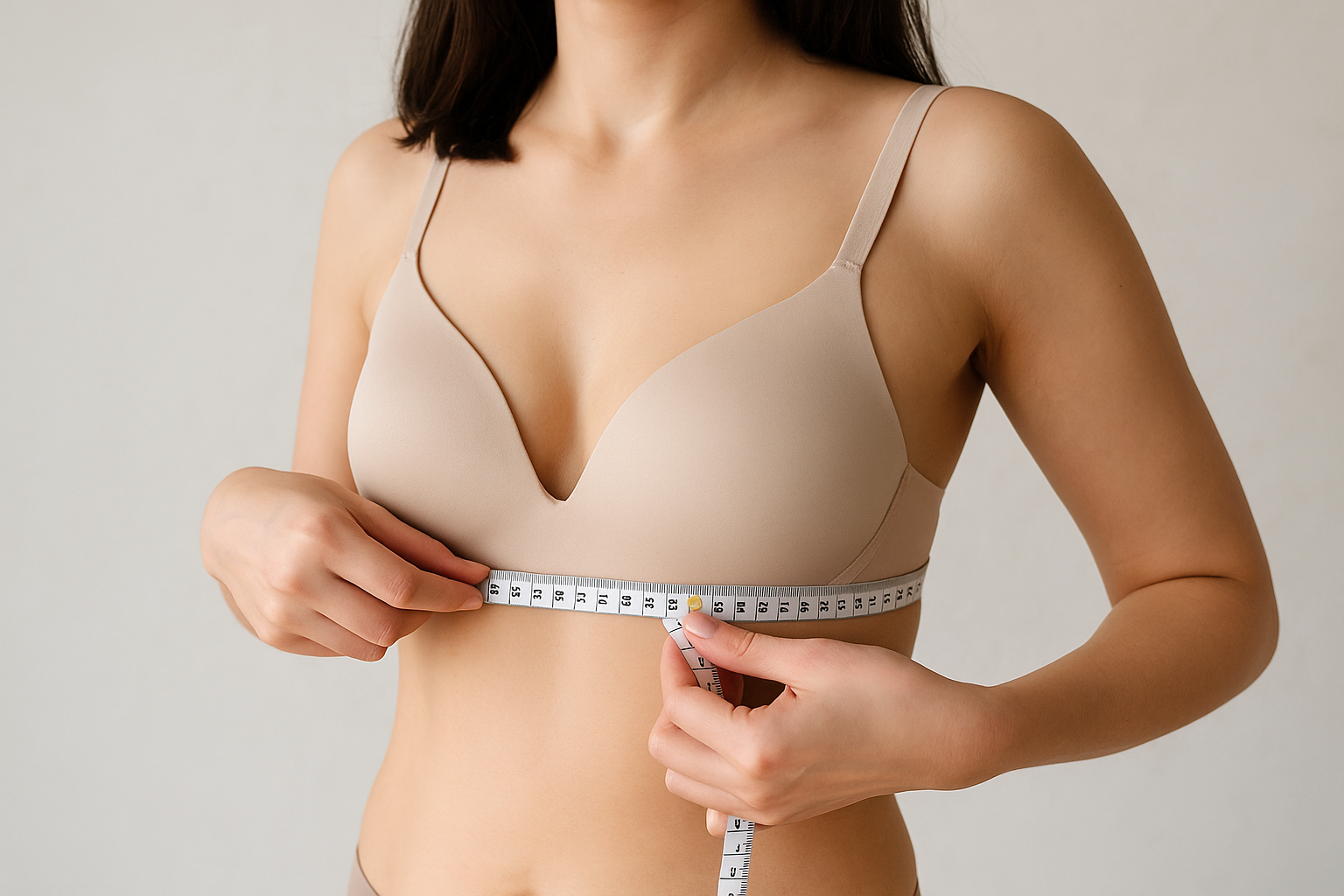
Wearing a non-padded bra, wrap the measuring tape snugly around your ribcage, directly under your bust. Use a mirror to ensure the tape is level around your torso.
Take the measurement in inches and round it to the nearest whole number. If the number is even, add four inches; if it's odd, add five inches. This is your band size. So, if you measure 30 inches, your band size is 34. If you measure 31 inches, your band size will be 36.
Step 2: Measure Your Bust Size
Stand straight and wrap the measuring tape around the fullest part of your bust, ensuring it's not too tight. The tape should be level and straight across your back.
When measuring, exhale and relax to avoid inflating your chest and skewing the measurement. Again, round the measurement to the nearest whole number.
Step 3: Calculate Your Cup Size
Subtract the band size from your bust size to find the difference. Here’s how you can determine your cup size:
- A difference of 1 inch = A cup
- A difference of 2 inches = B cup
- A difference of 3 inches = C cup
- A difference of 4 inches = D cup
- And so forth…
For example, if your band size is 34 inches and your bust size is 37 inches, the difference is 3 inches, indicating a C cup. Therefore, your bra size is 34C.
Common Mistakes and How to Avoid Them
While measuring at home is convenient, it's common to make mistakes that could lead to incorrect sizing. Here are some tips to ensure accuracy:
- Avoid Measuring Too Tightly: Your measuring tape should be snug yet comfortable, not too tight.
- Maintain a Relaxed Stance: Stand naturally without puffing your chest or holding your breath.
- Check for Level Tape: Use a mirror to ensure your measuring tape is level around your body.
- Re-measure If Unsure: It's helpful to measure twice for consistency, especially if you get varying results.
Adapting Your Bra Size to Different Brands
Keep in mind that sizes can vary slightly between brands. Some may have different sizing standards, making it helpful to check sizing guides on their websites before purchasing. Also, consider reading customer reviews that comment on fit.
For instance, a 34C in one brand might fit like a 32D in another. Knowing your sister size can be advantageous, especially during sales or when certain sizes are out of stock.
Understanding the Impact of Fabric and Style
The fabric and style of a bra influence comfort and fit. A lacy, no-stretch bra might feel tighter than a seamless, stretchy one in the same size.
Similarly, the style — whether it's a full-cup, demi-cup, or plunge — can alter fit and support levels. Experiment with different styles to find what enhances your comfort and suits your wardrobe best.
Online Resources and Customer Support
Shopping online doesn’t have to be daunting. Many lingerie websites now offer virtual fitting assistance, where you can chat with a fit specialist. This can provide further guidance tailored to your personal measurements and preferences.
Additionally, numerous retail sites include comprehensive fitting guides and reviews, making it easier to make informed decisions from home.
Conclusion: The Value of Finding Your Perfect Fit
Taking the time to measure accurately ensures more comfort, a better fit, and longer-lasting wear from your bras. It transforms how you look and feel in your clothes, boosting confidence and presenting you at your best.
As consumer options expand, education on finding the perfect fit enhances shopping satisfaction. Embrace this newfound empowerment and share your knowledge, helping others avoid the common pitfalls of bra shopping. Remember, the right fit is more than a number—it's about comfort, confidence, and carrying yourself gracefully.